Six air fryers, six different kitchens.
“Best air fryer” isn’t really one answer — a family cooking wings for four people needs something different than someone frying up a single portion of salmon in a studio apartment. Instead of picking one “winner” and calling it done, I tested and compared models built for different needs: big families, two-food households, small kitchens, and people who don’t want a coated metal basket. Here’s what actually works, and who each one is really for.

Ninja AF181 6.5-Qt Pro XL Air Fryer
The one to buy if you just want a single reliable basket that handles big portions without fuss — 6.5 quarts, Max Crisp mode, and dead-simple controls.
Check Price on Amazon→
Ninja DZ302 Dual 5-Qt Air Fryer
Two independent 5-quart baskets, two different temperatures, one Smart Finish that lines both up to land on the table together.
Check Price on Amazon→
Emeril Lagasse 26-Qt French Door Air Fryer Oven
Not really a “basket” air fryer at all — it’s a full countertop oven that air fries, fits a whole chicken or a 12-inch pizza, and swings open like a mini French-door fridge.
Check Price on Amazon→How I compared these
Every model on this list is a currently-sold, real product — not a paper spec sheet. I looked at basket/interior size against what it actually fits (wings by the pound, a whole chicken, a 12-inch pizza), how evenly food browned without shaking or flipping halfway, how loud the fan gets, how long cleanup takes, and where each one starts to struggle. None of these is the “best” for everyone — the point of this guide is matching the pick to your kitchen, not crowning a single winner.
Ninja AF181 6.5-Qt Pro XL Air Fryer — Best Overall
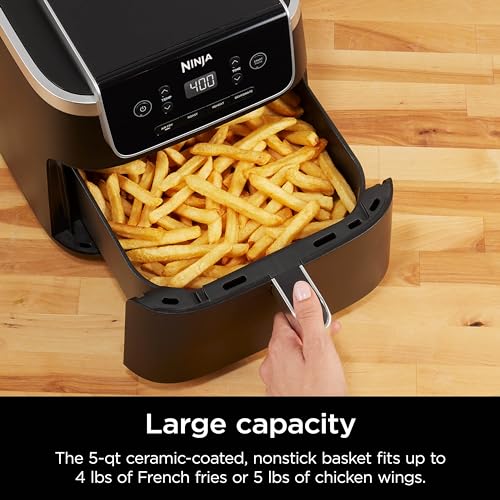
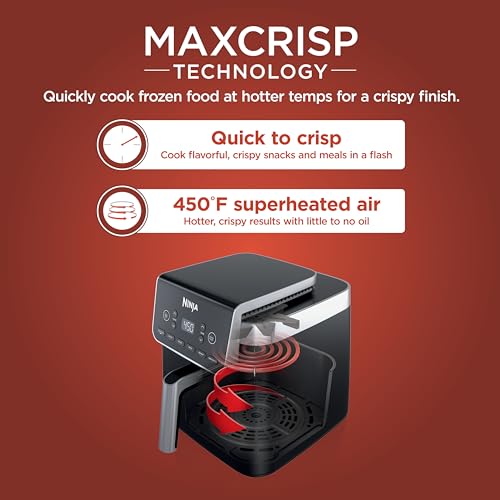
If you don’t want to think about which air fryer to buy and just want one that works, this is it. The 6.5-quart basket is big enough for close to 9 pounds of wings or a family-size batch of fries in one go, and the Max Crisp setting pushes the unit up to 450°F, which is where you actually get that shattering crunch instead of the slightly-soggy result cheaper fryers give you.
What stands out in daily use is how little you have to think about it. There’s no app, no fussy presets to memorize — Air Fry, Roast, Bake, Reheat, and Dehydrate cover almost everything a normal week throws at it, and the nonstick basket wipes clean in under a minute.
Pros:
- 6.5-quart basket handles family-size batches in one load
- Max Crisp mode gets noticeably crunchier results than standard air fry settings
- Nonstick basket and crisper plate clean up fast
- Straightforward controls — no learning curve
- Even browning without needing to shake constantly
Cons:
- Single basket — can’t cook two different foods at two different settings
- Takes up real counter space
- No window, so you can’t check progress without opening it
My Recommendation
This is the pick if you want one dependable basket and nothing to overthink. It’s the one I’d point a first-time air fryer buyer toward.
| Best for | Why |
|---|---|
| Families cooking one dish at a time | 6.5-quart capacity handles large batches without crowding |
| Wings, fries, roasted veg | Max Crisp gets real crunch, not just “air fryer beige” |
Ninja DZ302 Dual 5-Qt Air Fryer — Best for Two Foods at Once
The problem this one actually solves: cooking two things that need different times or temperatures without doing them back-to-back. Chicken thighs need longer and hotter than a batch of frozen fries — with two independent 5-quart baskets, they run on their own settings and the Smart Finish feature staggers the start times so both come out ready together, instead of one going cold while the other catches up.
It’s the closest thing to a real weeknight-dinner tool on this list, at the cost of being a genuinely large appliance — this isn’t going in a small cabinet when it’s not in use.
Pros:
- Two independent 5-quart baskets run different times/temps at once
- Smart Finish syncs both baskets to finish together
- Great for actual weeknight dinners with sides
- Same reliable even-heating Ninja is known for
Cons:
- Large footprint — measure your counter and storage space first
- Costs more than a single-basket model
- Two smaller baskets instead of one big one, if you only ever cook one dish
My Recommendation
Worth the extra size and cost if you regularly cook a main plus a side and are tired of the timing dance. Skip it if you usually only cook one thing at a time — the AF181 above does that better for less.
| Best for | Why |
|---|---|
| Weeknight dinners with a side | Two baskets, two settings, one finish time |
| Households that split preferences | Cook two different foods without cross-flavoring |
Emeril Lagasse 26-Qt French Door Air Fryer Oven — Best for Large Families
This one isn’t a basket air fryer at all — it’s a 26-quart countertop oven with air fry as one of its 24 presets, and it’s the only thing on this list that fits a whole chicken or a 12-inch pizza. The French doors open outward instead of down, which sounds minor until you’re loading a full sheet pan one-handed and not fighting a hot drop-down door.
The tradeoff is exactly what you’d expect: it’s heavier, it eats more counter space than anything else here, and there’s a real learning curve figuring out rack positions for multi-level cooking. But for a household that’s air frying dinner for five, not a snack for one, nothing else on this list has the capacity.
Pros:
- 26-quart interior fits a whole chicken or a 12-inch pizza
- French doors make one-handed loading easier and cut heat loss
- 24 presets cover toast, bake, roast, dehydrate, and air fry
- Seven included accessories mean fewer separate purchases
- Strong convection fan for even browning across multiple racks
Cons:
- Large, heavy, and needs real counter real estate
- Multi-rack cooking times take some trial and error at first
- Overkill if you’re only ever cooking for one or two people
My Recommendation
Buy this if capacity is your actual problem — hosting, meal prepping for a big household, or replacing a second oven. Everyone else will be better served by a basket-style pick above.
| Best for | Why |
|---|---|
| Big households and hosting | 26-quart capacity fits a whole chicken or full sheet pan |
| Replacing a second oven | 24 presets cover far more than basket air fryers can |
Ninja 4-in-1 Portable Glass Air Fryer (4-Qt) — Best Compact Pick

Small kitchen, dorm, RV, or just cooking for one or two — this is the pick that doesn’t eat your counter. The clear glass container means you can actually watch food brown instead of guessing, and it doubles as a storage container with a leak-proof lid, so leftovers or marinating chicken can go straight from fridge to fryer to fridge again.
Pros:
- Glass container lets you watch food cook in real time
- Doubles as a storage container with a leak-proof lid
- Dishwasher-safe glass — no coated basket to worry about
- Small enough for dorms, RVs, and tight counters
- Heats fast for 1–3 servings
Cons:
- 4-quart capacity is too small for a family meal
- Glass adds some weight versus a plastic basket
- Fewer functions than the oven-style picks above
My Recommendation
The right call for one or two people who don’t want a countertop-hogging appliance, or anyone who’d rather see their food cook than guess through a solid basket.
| Best for | Why |
|---|---|
| Small kitchens, dorms, 1–2 people | Compact glass container, small footprint |
| Meal prep and storage | Container goes from fridge to fryer to fridge |
Ninja Crispi Pro Glass Air Fryer, 6-Qt + 2.5-Qt — Best Premium Glass Option

Same glass-over-basket idea as the pick above, but scaled up and doubled: a 6-quart container for a main dish plus a 2.5-quart one for a side, both microwave- and freezer-safe. If you like the no-coating, see-through appeal of glass but need more than 4 quarts of capacity, this is the step up.
Pros:
- Two glass sizes (6-qt and 2.5-qt) cover a meal plus a side
- Microwave- and freezer-safe for real batch cooking
- Dishwasher-safe, no nonstick coating to wear out
- Lighter and less bulky than oven-style units
- Less lingering odor than a plastic-coated basket
Cons:
- Still less capacity than the oven-style Emeril above
- Priced higher than basic basket models
- Glass needs a bit more careful handling than plastic
My Recommendation
Good middle ground if the compact glass fryer above is too small but you don’t want (or don’t have room for) a full countertop oven.
| Best for | Why |
|---|---|
| Glass-fryer fans who outgrew the 4-qt size | 6-qt + 2.5-qt covers a main and a side |
| Batch cooking and reheating | Microwave- and freezer-safe containers |
Cuisinart TOA-70 Air Fryer Toaster Oven with Grill — Best Toaster-Oven Alternative
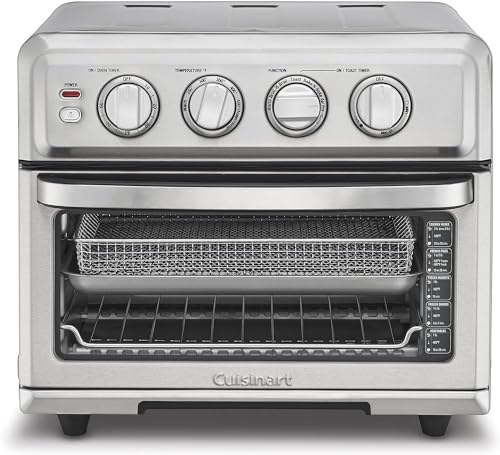
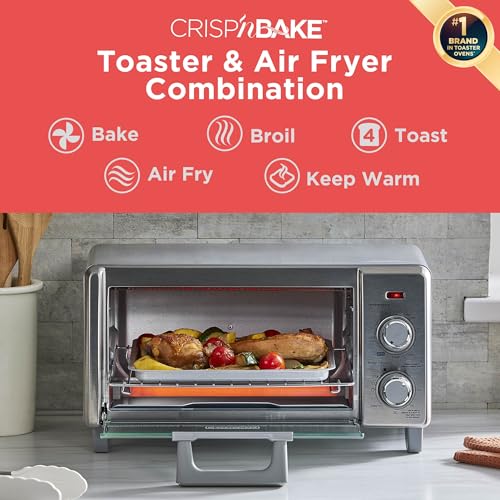
If the Emeril above is more oven than you need but you still want to fully replace a toaster, this 1800W Cuisinart splits the difference: 8-in-1 (air fry, bake, convection bake, grill, broil, toast, warm), simple manual dials instead of a touchscreen, and a glass door so you can actually watch things brown.
Pros:
- 1800W for fast preheat and steady heat
- 8-in-1 versatility including a real grill function
- Manual dials are fast and reliable, no menu-diving
- Glass door lets you monitor without opening it
- Front crumb tray makes toast/snack cleanup easy
Cons:
- Bigger footprint than a basket air fryer
- Rack placement takes some trial and error at first
- Fan is noticeable at higher settings
My Recommendation
A solid pick if you want one appliance to genuinely replace both your toaster and your air fryer, and you’d rather turn a dial than tap a screen.
| Best for | Why |
|---|---|
| Replacing a toaster and an air fryer at once | 8-in-1 functions including toast and grill |
| People who prefer manual dials | No touchscreen menus to learn |
How to pick between them
Basket or oven-style? A basket air fryer (the AF181, DZ302, or either glass model) is faster to preheat and easier to store, but it’s built for pieces — wings, fries, chicken thighs — not a whole roast. An oven-style unit like the Emeril or the Cuisinart trades some speed and counter space for real capacity and versatility.
How many people are you actually cooking for? One or two: the 4-quart glass pick. A family cooking one dish at a time: the AF181. A family that wants a main and a side ready together: the DZ302. Hosting or cooking for five-plus: the Emeril.
Do you care about the basket material? If you’d rather not deal with a nonstick coating, both Ninja glass models skip it entirely — worth the tradeoff in capacity for a lot of people.
Budget matters too — if you just want something small and cheap to try air frying for the first time, see our budget air fryer picks under $50 instead of any of the models above.
FAQs
What size air fryer should I buy?
For one or two people, 4 quarts is plenty. For a family of three or four, look at 5–6.5 quarts. For five or more, or if you want to fit a whole chicken, you need an oven-style unit like the Emeril above rather than a basket.
Is a glass air fryer actually better than a coated basket?
Not objectively “better,” but it solves a specific worry — no nonstick coating to wear down over time, and you can see the food as it cooks. The tradeoff is usually less capacity for the price.
Do I need the dual-basket feature?
Only if you regularly cook two things that need different times or temperatures. If you mostly cook one dish per meal, a single larger basket is simpler and cheaper.
How do I get crispier results?
Don’t overcrowd the basket — cook in batches if needed. A light spray of oil helps more than people expect, and preheating for 2–3 minutes makes a real difference on frozen food.
Final Verdict
There isn’t one best air fryer — there’s a best air fryer for what you’re actually cooking and how many people you’re cooking for. For most people replacing a first air fryer, the Ninja AF181 is the safest, least complicated buy. If dinner means two dishes at once, the Ninja DZ302 earns its extra size. And if you’re cooking for a full table, nothing here beats the capacity of the Emeril Lagasse 26-Qt.